 OneClickGrowth
GEO vs Traditional SEO: Key Differences and Why It Matters for Your Brand
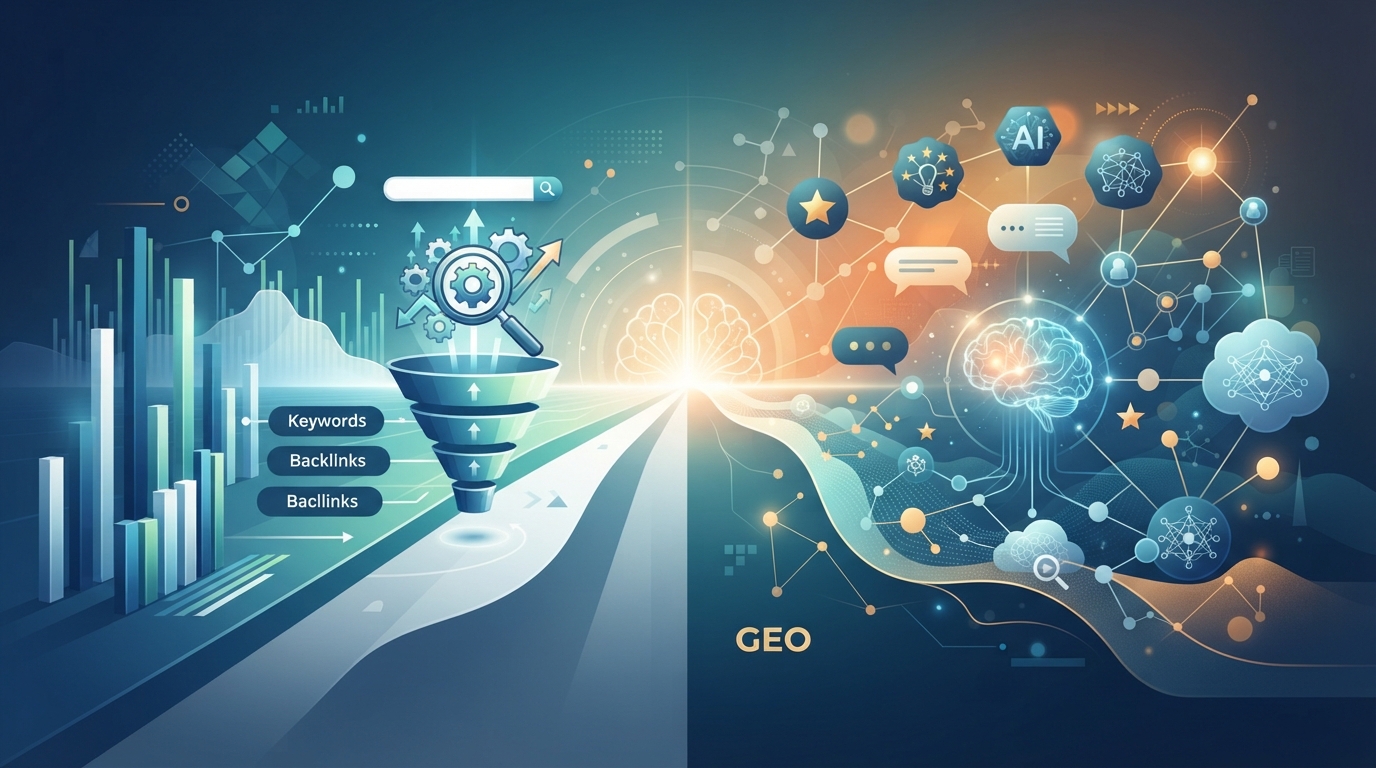
In 2026, search behaviour is undergoing its most significant transformation since the inception of the commercial internet. Users are increasingly bypassing traditional lists of blue links in favour of direct, synthesised answers provided by generative artificial intelligence models. This shift from querying a search engine to conversing with an AI companion has created a critical divergence in how online content must be prepared, structured, and distributed.
For businesses aiming to maintain and expand their digital footprint, relying solely on legacy optimisation tactics is no longer sufficient. Traditional Search Engine Optimisation (SEO) remains a valuable discipline, but it must now coexist with—and adapt to—Generative Engine Optimisation (GEO). Understanding the precise distinctions between these two methodologies is the first step towards securing your brand's presence in a conversational search ecosystem.
The Evolution of Search: Understanding Traditional SEO vs GEO
Traditional SEO was built on the premise of discovery via indexing. Search engine crawlers traverse the web to index pages, categorise them based on keywords, and rank them using algorithms that heavily weigh backlink profiles, domain authority, and technical performance. The ultimate goal of traditional SEO is to drive clicks to a specific webpage by ranking as high as possible on a Search Engine Results Page (SERP). Success is measured in organic sessions, impressions, and click-through rates.
Generative Engine Optimisation, by contrast, focuses on visibility within AI-generated summaries and conversational answers. When a user asks a complex question, a generative engine does not merely return a list of websites; it synthesises information from multiple sources to compose a single, coherent response. GEO is the discipline of structuring your content so that these large language models (LLMs) select your brand as a primary source, cite your website within their synthesis, and recommend your services.
While traditional SEO optimises for algorithms that rank documents, GEO optimises for algorithms that synthesise knowledge. This fundamental difference alters how content must be researched, drafted, and formatted to ensure maximum visibility in a landscape dominated by AI-driven responses.
How Retrieval-Augmented Generation (RAG) Redefines Visibility
To understand why GEO requires a different approach, one must look at the technology driving modern search engines: Retrieval-Augmented Generation (RAG). When a user inputs a query, a generative engine uses RAG to pull relevant, real-time data from external web sources before generating an answer. This prevents the model from relying solely on its pre-trained data, ensuring that information remains current and accurate.
In a traditional search framework, a user keys in a short query, and the search engine matches those keywords to indexed pages. In a RAG-driven framework, the system retrieves segments of text from across the web that best answer the query, feeds those segments into the LLM, and produces a conversational summary. Your brand’s objective is to be included in that retrieval pool.
Optimising for RAG requires a move away from simple keyword density. Instead, content must be highly authoritative, factually dense, and structured in a way that allows retrieval models to easily parse and extract key statements. If your content cannot be easily categorised and extracted by an AI’s retrieval mechanism, it will be omitted from the final synthesized response, regardless of how high your traditional domain authority might be.
Keyword Matching vs Semantic Intent and Brand Authority
For nearly three decades, keyword research was the foundation of digital marketing. Marketers targeted specific high-volume, low-competition keywords and placed them strategically within headers, meta descriptions, and body text. While semantic search has gradually reduced the rigidity of this practice, traditional SEO still heavily relies on alignment with specific search terms.
GEO shifts the focus entirely to semantic intent and comprehensive authority. Generative engines do not look for exact keyword matches; they look for the most complete, accurate, and contextually relevant answer to a user's multi-layered question. A query in 2026 is rarely a two-word phrase; it is often a detailed scenario or a conversational prompt requiring nuanced comparison and analysis.
To capture visibility in this environment, your content must address the broader context surrounding a topic. This involves answering secondary and tertiary questions, providing verified data points, and establishing clear industry expertise. Generative models naturally favour sources that offer unique, first-party insights, original research, and clear consensus-driven facts over generic, rehashed articles that offer no new value to the information ecosystem.
Content Structuring for LLMs: Beyond the Traditional Meta Tags
In traditional SEO, technical optimisation often revolves around meta titles, descriptions, heading tags (H1, H2, H3), and XML sitemaps. While these elements remain essential for structural clarity, generative models require a much deeper layer of semantic organisation to digest and utilise information effectively.
AI models thrive on structured data and clear formatting. Implementing schema markup, utilising bulleted lists for complex data, and adopting a clear 'claim-evidence-source' writing style makes it significantly easier for generative engines to pull your content into their summaries. When you make a claim, support it immediately with data or a verified source, as this structure mirrors the reasoning processes of advanced LLMs.
Furthermore, directness is highly rewarded in GEO. Instead of burying key information under long, atmospheric introductions, content must address the core user intent within the first few paragraphs. Generative engines prioritise efficiency; they are designed to extract the absolute best answer in the shortest amount of time. By structuring your content to deliver immediate, high-value answers, you drastically increase the likelihood of being cited as a primary reference.
Measuring Success: From Keyword Rankings to Share of Model (SoM)
One of the most profound differences between traditional SEO and GEO lies in how success is measured. For years, digital marketers relied on rank-tracking tools to monitor their positions for target keywords. If a brand ranked in the top three positions on Google, success was virtually guaranteed.
In the era of generative search, traditional rank tracking is losing its utility. Users are interacting with synthesised modules where traditional 'rankings' do not exist in a linear fashion. Instead, marketers must focus on 'Share of Model' (SoM)—the frequency and sentiment with which a brand is mentioned, cited, and recommended across various generative engines.
Measuring Share of Model requires analytical tools that can monitor conversational outputs, assess the context of brand mentions, and evaluate whether your content is being integrated into AI-generated recommendations. This shift requires a broader perspective on analytics, moving away from simple click tracking towards comprehensive brand visibility, citation attribution, and conversational sentiment analysis.
Adapting Your Strategy: Actionable Steps to Transition to GEO
Transitioning from a traditional SEO mindset to a GEO-focused strategy does not mean abandoning your existing search practices. Rather, it requires enhancing your current workflow with tools and methodologies designed specifically for the generative age. This is where a unified discovery platform becomes indispensable.
Using OneClickGrowth, businesses can seamlessly bridge the gap between traditional SEO and GEO. Our AI-driven Website Analysis scans your existing digital assets to identify how effectively your content can be parsed by modern generative models. By highlighting content gaps, structural inefficiencies, and areas where your brand authority needs reinforcement, the platform provides a clear, step-by-step roadmap to optimise for conversational search.
Once gaps are identified, our Content Strategy Planning and Content Ideation features help you generate authoritative, structured content that directly aligns with user intent and RAG retrieval mechanisms. Rather than guessing what LLMs are looking for, OneClickGrowth automates the identification of high-value conversational topics, allowing your team to produce high-quality, referenceable material at scale.
The Future of Digital Visibility in a Generative-First World
As we look deeper into 2026 and beyond, the integration of generative AI into daily life will only accelerate. The brands that secure their positions as trusted, authoritative sources within these models today will enjoy a compounding advantage in the years to come. Conversely, those that continue to rely solely on legacy SEO techniques risk becoming invisible to a generation of users who expect instant, synthesised answers.
Preparing for this future requires a proactive, technology-driven approach. By understanding the core differences between traditional SEO and GEO, and by leveraging advanced platforms like OneClickGrowth to audit, plan, and execute your content strategy, you can ensure your business remains highly visible, highly cited, and continuously trusted by both traditional search engines and generative models alike.
Conclusion
Traditional SEO laid the groundwork for online discovery, but GEO is the framework that will define the future of digital visibility. The shift from keywords to conversational intent, from indexing to synthesised answers, and from linear rankings to Share of Model requires a modern, sophisticated approach to digital marketing. By aligning your content strategy with the technical requirements of generative engines, you position your brand to thrive in a landscape where answers are generated in real-time, and authority is the ultimate currency.
Frequently Asked Questions
Can I completely replace my traditional SEO strategy with GEO?
No, GEO is not a replacement for traditional SEO but an extension of it. While GEO focuses on visibility within AI-generated answers and summaries, traditional SEO still ensures your technical infrastructure is sound, your pages load quickly, and your site is indexable. A successful modern strategy combines both disciplines.
What is Share of Model (SoM), and how is it calculated?
Share of Model (SoM) measures how frequently and positively your brand is cited or recommended by generative AI engines relative to your competitors. It is calculated by analysing conversational query outputs across various LLMs to determine your brand's presence in their synthesised responses.
How does OneClickGrowth help with Generative Engine Optimisation?
OneClickGrowth provides AI-driven Website Analysis to evaluate how easily generative engines can retrieve and synthesise your content. It also offers Content Strategy Planning and automated workflows to help you create structured, authoritative content that aligns perfectly with LLM retrieval requirements.
Does schema markup still matter for GEO?
Yes, schema markup is highly beneficial for GEO. Structured data helps generative models parse and understand the context of your content more efficiently, increasing the likelihood that your data, products, or reviews will be pulled into AI-generated answers and direct citations.