 OneClickGrowth
The Evolution of Search: Why Traditional SEO Platforms Are Yielding to AI-Driven Discovery
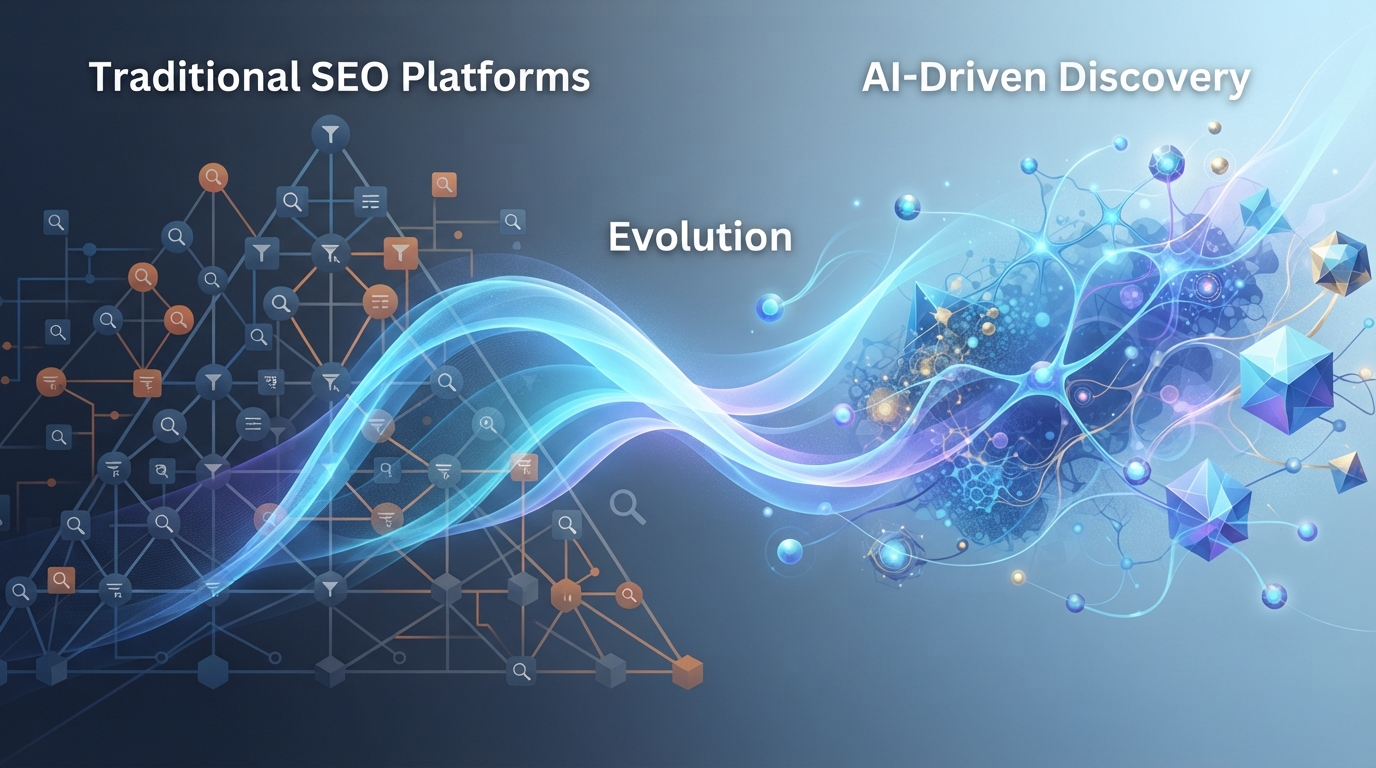
A fundamental shift is occurring in how British audiences seek information online. Rather than entering fragmented, three-word queries into a search box and scrolling through pages of blue links, users increasingly converse with generative engines to receive synthesised, contextual answers. This evolution means that traditional search engine optimisation methods are no longer sufficient on their own. Businesses must now optimise not just for conventional search algorithms, but for the large language models that power conversational search.
For organisations seeking to maintain and grow their online visibility, this shift requires a new approach to digital marketing. Legacy SEO tools that rely purely on historical search volume and keyword density are failing to capture the nuances of conversational queries. OneClickGrowth bridges this gap by offering a comprehensive, AI-powered marketing discovery platform designed for the modern search environment, combining traditional search principles with advanced Generative Engine Optimisation (GEO).
The Shift from Search Indexing to Generative Synthesis
Historically, search engines operated as digital directories, indexing web pages and matching keyword queries with the most relevant documents. In 2026, the search environment is defined by synthesis. Generative search experiences pull information from across the web, parse the intent of the user, and present a cohesive, natural-language response. This means your content is no longer simply competing for a spot in a list; it is competing to be the trusted source that the AI model cites within its synthesised answer.
This transition has altered user behaviour. Instead of conducting multiple separate searches to compare products or services, users now ask complex, multi-turn questions. A user might ask for a comparison of enterprise software solutions that meet specific UK regulatory standards, all within a single prompt. If your brand’s content is not structured to be easily digested, synthesised, and cited by generative engines, it risks becoming invisible to a rapidly growing segment of your target market.
Adapting to this change does not mean abandoning SEO; rather, it requires expanding your strategy to encompass generative engines. This is where OneClickGrowth provides an essential advantage, analysing how generative models interpret your website's content and ensuring your brand remains a primary source of authority.
Understanding Generative Engine Optimisation (GEO)
Generative Engine Optimisation, or GEO, is the practice of structuring and refining digital content so that it is accurately understood, categorised, and cited by generative AI platforms. Unlike traditional SEO, which focuses heavily on keyword placement and backlink profiles, GEO prioritises semantic depth, factual accuracy, and authoritative structuring. Generative models look for content that directly answers complex queries with clear, verifiable evidence.
To succeed with GEO, brands must focus on context and authority. This involves using structured data, clear schema markups, and authoritativeness signals that prove to AI models that your information is trustworthy. When an AI engine generates a response, it evaluates the credibility of the sources it draws from. If your content lacks clear attribution or reads as superficial, it will be bypassed in favour of more robust, expert-led resources.
OneClickGrowth simplifies this complex process. Our platform evaluates your digital footprint against the specific retrieval mechanisms of modern generative engines. By identifying how well your content aligns with these retrieval algorithms, we help you make the precise adjustments needed to secure high-value citations within AI-generated summaries.
The Pitfalls of Legacy SEO Tooling in a Conversational Era
Many marketing teams continue to rely on legacy SEO platforms designed over a decade ago. These tools are built on the assumption that search is linear and keyword-driven. They track search volume for static phrases and suggest content updates based on rigid, outdated formulas. However, in an era where search queries are highly conversational and context-dependent, relying solely on these metrics can lead to misplaced effort and declining organic traffic.
Traditional tools often fail to highlight content gaps that matter to modern consumers. They might tell you that a certain keyword has high search volume, but they cannot tell you why users are searching for it, what secondary questions they are asking, or how generative engines are currently answering those queries. This leaves brands writing content that ranks for low-intent keywords while missing the broader conversational touchpoints where purchasing decisions are actually made.
By moving away from static keyword tracking and adopting OneClickGrowth's AI-driven approach, businesses gain a deeper understanding of search intent. Our platform looks beyond simple search volumes to analyse semantic clusters and conversational query patterns, ensuring your content addresses the exact questions your audience is asking.
Real-Time Content Gap Identification with OneClickGrowth
One of the greatest challenges for modern digital marketers is identifying where their content strategy is falling short. Manually auditing a website to find content gaps is incredibly time-consuming and prone to human error. OneClickGrowth addresses this by automating the website analysis process, scanning your existing pages to identify critical gaps in real-time.
Our AI-driven website analysis does not just look for missing keywords; it evaluates the depth, structure, and relevance of your existing content. It compares your site's architecture and information depth against the broader digital landscape and the specific requirements of generative engines. The platform then highlights areas where your content lacks the authority or detail required to be featured as a primary source.
Once these gaps are identified, OneClickGrowth provides a simplified, step-by-step growth plan. This takes the guesswork out of content creation, giving your team a clear, prioritised roadmap of exactly what content needs to be written, updated, or restructured to maximise visibility across both traditional and generative search platforms.
Streamlining Content Workflows for Scaling Agencies
For digital marketing agencies, managing content strategies across multiple client accounts presents a significant operational challenge. Coordinating research, strategy, content ideation, and approval workflows often leads to bottlenecks, slowing down execution and limiting client growth. OneClickGrowth offers a dedicated solution to these agency pressures through our Agency Partner Management Dashboards.
This centralised dashboard allows agencies to oversee all client campaigns from a single interface, offering real-time insights into content performance, GEO health, and outstanding tasks. By automating the tedious aspects of content ideation and workflow planning, agencies can focus their energy on high-level strategy and client relationships, rather than getting bogged down in spreadsheet management.
Furthermore, our built-in content ideation and workflow automation tools ensure that every piece of content produced is pre-optimised for modern search. The platform generates detailed briefs based on real-time gap analysis, ensuring writers understand the exact semantic terms, structural requirements, and intent-driven angles needed to win both traditional rankings and AI citations.
Measuring Visibility in the Age of AI Retrieval
In the traditional search paradigm, success was measured by keyword rankings. While tracking whether your site ranks in the top three positions for a specific term is still useful, it no longer tells the whole story. In an AI-driven search ecosystem, brands must measure their 'Share of Model Voice'—how often and how prominently their brand is cited within generative search answers.
Measuring this requires a sophisticated understanding of how AI engines retrieve and synthesise information. It is no longer enough to look at impressions and clicks; marketers must understand the sentiment, context, and frequency with which their brand is mentioned by conversational engines. If a generative search tool recommends your service but links to a competitor for pricing, your visibility strategy has a critical leak.
OneClickGrowth provides the analytics and insight tools needed to monitor and improve your brand’s presence within generative outputs. By tracking citation patterns and conversational visibility, we help you understand how your brand is perceived by AI models, allowing you to continually refine your content to maintain a dominant position in synthesised search results.
Crafting a Future-Proof Content Roadmap
Achieving long-term organic visibility requires a content strategy that is both agile and resilient. As search algorithms and generative models continue to evolve, static content strategies will inevitably fall behind. A future-proof roadmap must be built on continuous analysis, rapid execution, and constant optimisation.
To build this roadmap, organisations should start by deeply analysing their existing content assets using OneClickGrowth’s AI-powered auditing tools. From there, categorise your content into structural clusters that address specific user journeys and informational needs. Ensure that every page serves a clear purpose, contains high-quality, original data, and is structured in a way that both humans and AI models can easily parse.
Finally, establish a continuous feedback loop. Use OneClickGrowth to monitor changes in search behaviours, track generative citation patterns, and automatically update your content roadmap as new gaps emerge. By treating content strategy as an active, automated lifecycle rather than a one-off project, your brand will remain visible, authoritative, and trusted, no matter how the search landscape changes.
Conclusion
The transition from legacy search to AI-driven generative discovery is well underway, and the businesses that adapt first will capture the lion's share of digital visibility. Relying on outdated SEO tactics is no longer a viable path to growth. By embracing Generative Engine Optimisation and leveraging OneClickGrowth’s AI-powered platform, you can automate your content discovery, identify critical gaps, and execute a sophisticated content strategy that wins across all search platforms.
Frequently Asked Questions
What is the main difference between traditional SEO and Generative Engine Optimisation (GEO)?
Traditional SEO focuses on positioning web pages at the top of search engine results pages using keywords, backlinks, and technical site performance. GEO focuses on structuring and refining content so that generative AI models (such as SearchGPT, Gemini, and others) can easily understand, synthesise, and cite your brand as an authoritative source within conversational answers.
How does OneClickGrowth identify content gaps on my website?
OneClickGrowth uses advanced AI-driven website analysis to scan your existing pages and compare them against real-time search trends and conversational query models. It evaluates the depth, structure, and semantic relevance of your content, pinpointing exactly where your site lacks the detailed information and authority required to be featured in generative search summaries.
Can marketing agencies use OneClickGrowth to manage multiple clients?
Yes. OneClickGrowth features dedicated Agency Partner Management Dashboards designed specifically for agencies. This interface centralises client campaigns, streamlines content ideation, automates workflows, and provides real-time performance insights, allowing agencies to scale their operations and deliver consistent GEO and SEO results.
Is traditional keyword research still useful in 2026?
Traditional keyword research is still valuable for understanding search demand, but it must be integrated with semantic clustering and conversational intent analysis. OneClickGrowth combines traditional search metrics with AI-driven discovery to ensure your content targets the actual questions and natural-language queries that users ask.