 OneClickGrowth
Transforming SEO Reporting and Strategic Planning with Actionable AI
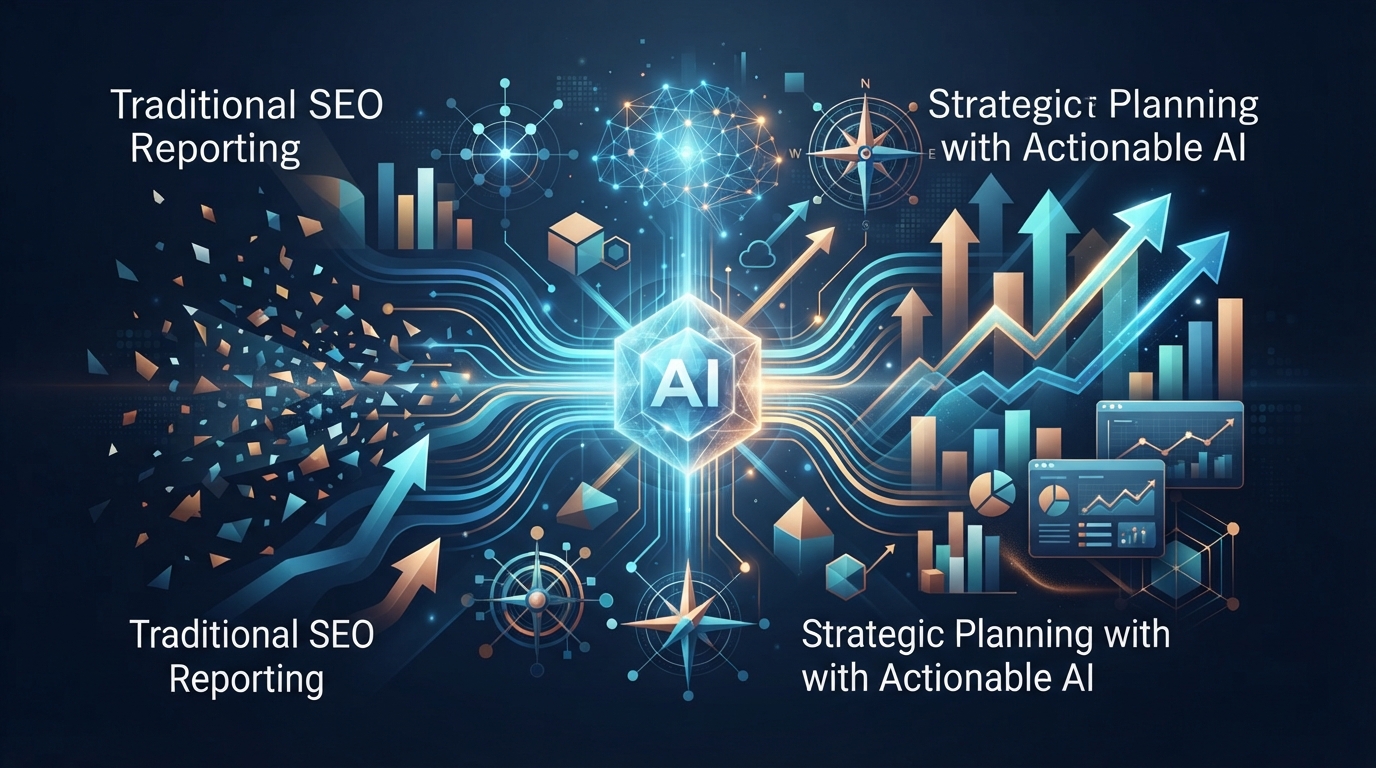
Marketing teams across the United Kingdom spend an estimated thirty per cent of their working hours manually extracting, formatting, and compiling monthly search performance data. By the time these spreadsheets are delivered to stakeholders, the insights are already weeks out of date, offering a retrospective look at search behaviour rather than a forward-looking roadmap. In an era where search behaviour is shifting rapidly toward conversational queries, relying on reactive, static reporting guarantees that your brand remains one step behind.
The integration of artificial intelligence into organic search management fundamentally changes this dynamic. Instead of merely documenting what occurred in the past, intelligent platforms synthesise historical performance with real-time intent signals, translating raw data into a clear path forward. By automating the transition from analysis to execution, brands can spend less time organising spreadsheets and more time capturing market share across both traditional search engines and emerging conversational platforms.
The Shift from Reactive Analytics to Predictive Strategy
Traditional search engine reporting has long been characterised by looking backward. Teams pull monthly search volumes, keyword rankings, and organic session data, presenting them in static slide decks that fail to explain the underlying causes of performance shifts. While this historical record is useful for compliance, it offers very little strategic value. In a market where consumer intent shifts overnight, relying on old data prevents businesses from seizing immediate opportunities.
Predictive SEO planning, enabled by advanced machine learning models, shifts the focus from documentation to anticipation. By analysing search trends, user engagement patterns, and systemic shifts across search landscapes, AI identifies emerging search patterns before they manifest as high-volume keywords. This early detection allows marketing teams to secure early rankings on high-intent topics, establishing topical authority long before legacy tools flag the opportunity.
Furthermore, predictive strategy minimises the risks associated with algorithm updates. Instead of reacting to sudden drops in organic visibility after an update occurs, AI-driven website analysis flags potential vulnerabilities in structure, content quality, and entity alignment beforehand. This allows teams to proactively harden their digital presence, ensuring consistent performance regardless of search engine volatility.
Automating the Site Audit with AI-Driven Website Analysis
For many digital agencies and enterprise brands, the technical and content site audit is an incredibly labour-intensive process. Teams must run crawlers, export massive CSV files, filter out noise, and manually cross-reference pages with conversion data to identify underperforming content. This manual workflow often leads to analysis paralysis, leaving valuable insights buried in spreadsheets while implementation stalls.
With OneClickGrowth’s AI-driven website analysis, this process is entirely automated and continuous. Rather than treating site health as a quarterly event, the platform constantly monitors your digital footprint, identifying structural errors, duplicate content, and declining search visibility. The AI contextualises these findings, ranking tasks not just by technical severity but by their potential impact on organic traffic and revenue.
By automating this layer of discovery, teams can immediately see where their digital architecture requires reinforcement. Whether it is addressing a critical drop in indexation or identifying high-traffic pages that lack clear conversion pathways, the platform delivers prioritised action items. This transforms auditing from a tedious diagnostic chore into an active, continuous feedback loop that drives performance improvements.
Navigating the Era of Generative Engine Optimization (GEO)
Traditional search engine optimization focuses heavily on securing a place within the ten blue links on a results page. However, the rise of large language models and conversational search engines has fundamentally altered how users consume information online. Rather than browsing websites, users are increasingly presented with synthesised answers that cite specific sources directly within the AI-generated interface.
This shift requires a transition from traditional SEO to Generative Engine Optimization (GEO). Success in this environment is no longer measured solely by keyword ranking; it is measured by inclusion in the context packages and citations of conversational search agents. To win in this space, brands must understand the precise intent, formatting, and structural styles that generative engines prefer when selecting sources to cite.
OneClickGrowth helps brands adapt to this shift by analysing how conversational engines perceive their content. By evaluating website copy against the training preferences and synthesis behaviours of modern LLMs, the platform identifies content gaps that prevent your brand from being selected as an authoritative source. This allows your team to optimise content structure, improve entity relationships, and secure valuable visibility in the AI-synthesised answers of tomorrow.
Building Actionable Content Roadmaps Through AI Synthesis
Having a list of keyword opportunities is useless without a clear plan for execution. Too often, content planning sessions involve guesswork, subjective opinions, and long debates over which topics to prioritise. This disconnect between data analysis and content production frequently results in disjointed, low-impact content schedules that fail to move the needle.
Effective content strategy planning requires a systematic approach to identifying and filling topical gaps. AI streamlines this process by analysing competitor content, search engine results pages, and natural language trends to determine exactly what information is missing from your domain. It maps out topical clusters, ensuring that your content strategy covers every stage of the user journey from initial discovery to commercial intent.
Once the content gaps are identified, the planning phase transitions seamlessly into execution. The platform generates comprehensive briefs that outline the target intent, necessary headings, critical entity associations, and structural requirements for each piece of content. By providing writers with data-backed blueprints, brands can eliminate creative friction, speed up production times, and ensure that every article published is highly optimised for both human readers and search engines.
Streamlining Agency Operations with Centralised Partner Dashboards
For marketing agencies, reporting is often the single most significant administrative bottleneck. Account managers spend countless hours logging into multiple tools, compiling custom reports for different clients, and trying to explain complex technical concepts in layman's terms. This overhead reduces the time agencies can spend on strategic execution, limiting their capacity to scale and deliver true value to clients.
OneClickGrowth addresses this challenge with dedicated Agency Partner Management Dashboards. Designed to streamline client communications, these centralised dashboards provide agencies with a single source of truth for all client campaigns. Instead of sending static PDFs at the end of each month, agencies can offer clients transparent, real-time access to progress, task completion, and organic search impact.
This level of clarity strengthens client relationships and reduces churn. When clients can see exactly how content strategies are progressing, which technical issues have been resolved, and how these efforts correspond to growth in organic visibility, confidence increases. Agencies can pivot their client conversations from explaining historical search metrics to discussing high-level strategy and market expansion.
Overcoming the Data Puke Dilemma in Executive Reporting
Many organic search reports suffer from what industry professionals call the 'data puke' dilemma—overwhelming stakeholders with hundreds of meaningless metrics that lack business context. Chief executives and marketing directors do not need to know the crawl budget or internal link count of every subfolder; they want to know how search visibility is impacting the brand’s overall market share and customer acquisition costs.
AI-powered reporting solves this problem by translating technical indicators into business intelligence. By filtering out irrelevant technical noise, the platform focuses on executive-level metrics: share of voice, competitive positioning, content performance, and visibility across generative search engines. This allows marketing teams to present clear, concise, and highly visual reports that demonstrate the direct ROI of their search efforts.
When reports are framed in terms of business outcomes rather than abstract search mechanics, securing budget for future campaigns becomes substantially easier. The C-suite can clearly see how strategic content investments are driving organic brand discovery, positioning search not as a cost center, but as a primary driver of sustainable, long-term business growth.
Executing with Speed: Content Ideation and Workflow Automation
Even the most sophisticated SEO report is useless if it sits on a shelf. The ultimate test of any planning platform is how quickly it allows a brand to act on insights. When there is a delay of several weeks between discovering a search trend and publishing a relevant piece of content, the opportunity is often lost to more agile competitors.
By integrating content ideation with workflow automation, OneClickGrowth bridges the gap between insight and execution. The platform does not just point out where you are losing visibility; it actively suggests new content ideas, automates brief generation, and coordinates tasks across your editorial team. This eliminates administrative friction, allowing teams to move from identification to publication in a fraction of traditional timelines.
This accelerated workflow is particularly valuable when addressing sudden shifts in search behaviour or competitive moves. Instead of scheduling long cross-departmental alignment meetings, your marketing team can rely on automated workflows to quickly draft, optimise, and publish content that responds to current market demands. In a fast-moving digital environment, speed of execution is the ultimate competitive advantage.
Conclusion
Managing search engine visibility in a changing digital environment requires a complete departure from the manual, slow-moving reporting methodologies of the past. Success belongs to brands that can quickly analyse their current performance, identify critical content gaps, and execute coordinated growth strategies without friction. By embracing AI-driven reporting and strategic planning, businesses can move beyond retrospective metrics and actively shape their search destiny.
OneClickGrowth provides the comprehensive suite of tools necessary to lead this transition. From deep site analysis and agency partner dashboards to advanced content planning and generative engine optimization, the platform is designed to make growth simple, visible, and highly automated. Empower your team to stop managing spreadsheets and start driving organic search dominance across every search channel that matters.
Frequently Asked Questions
What is the main benefit of using AI for SEO reporting instead of traditional tools?
Traditional tools focus on historical data, showing what happened weeks ago in a reactive manner. AI-driven reporting monitors search environments in real time, predicts emerging trends, identifies content gaps, and converts raw data into an actionable, prioritised growth plan immediately.
How does Generative Engine Optimisation (GEO) differ from traditional SEO?
Traditional SEO focuses on optimizing for keywords to appear in search engine results pages (SERPs). GEO optimises website content so that it is easily understood, indexed, and cited by conversational AI engines like ChatGPT, Gemini, and Claude when answering user queries.
Can OneClickGrowth help digital agencies scale their reporting?
Yes, our Agency Partner Management Dashboards consolidate all client data into a single, transparent interface. This eliminates the need for manual monthly reporting, giving clients real-time visibility into strategy execution, content performance, and ROI.
How does AI automate the content creation workflow?
The platform identifies high-value content gaps, generates highly detailed, data-backed writing briefs, and coordinates workflows. This allows content creators to draft highly targeted copy that matches user intent and entity requirements, accelerating publication timelines.